
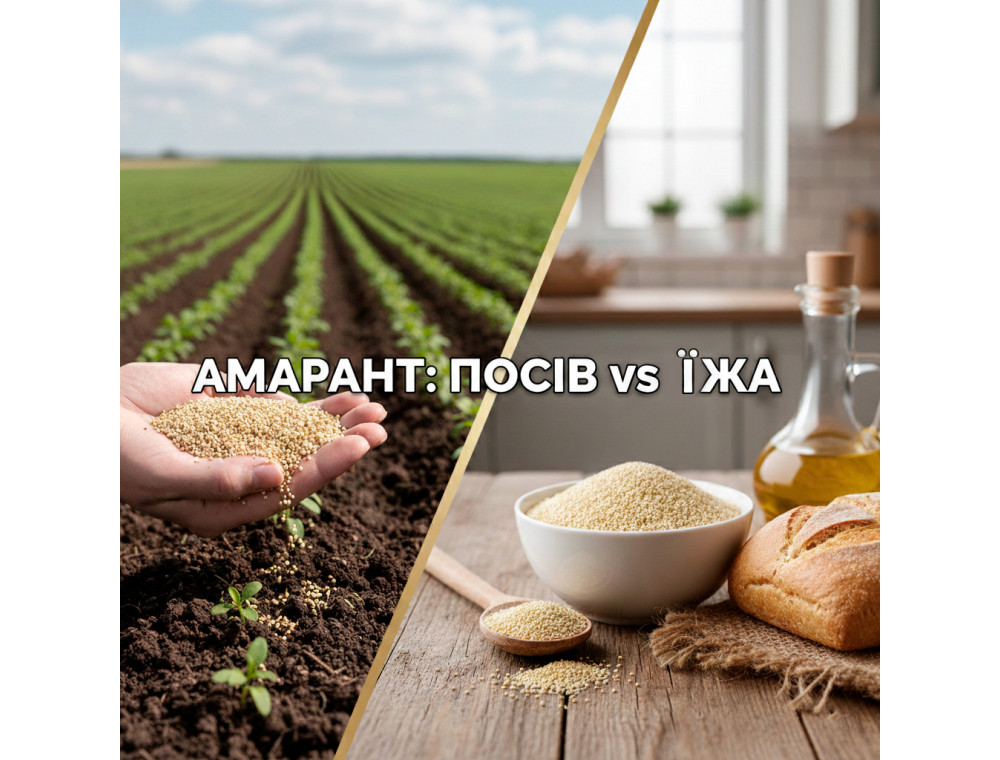
Amaranth Seeds vs. Amaranth Grain: What is the Difference?
Many customers confuse sowing material with food-grade grain. However, these are two distinct products with different cultivation requirements, storage standards, and certifications. "Amaranth of Ukraine" explains the key differences to help you make an informed choice and achieve guaranteed results.
Key Definitions
Amaranth Seeds – Specialized sowing material of high reproduction. It features guaranteed germination rates, high growth energy, and strict varietal purity.
Amaranth Grain – A food-grade raw material. It is used for producing oil, flour, and grits, as well as for cooking, sprouting, or as high-quality feed for livestock and poultry.
Comparison: Sowing Seeds vs. Food-Grade Grain
| Feature | Sowing Seeds (for Planting) | Food-Grade Grain (for Consumption) |
| Primary Goal | High yield and variety preservation | Nutritional value and processing |
| Key Indicators | Germination rate, growth energy, purity | Squalene content, oil yield, purity of cleaning |
| Technology | Strict spatial isolation from weeds/wild types | Controlled cultivation (isolation is less critical) |
| Documentation | Quality certificates, varietal passports | Food safety protocols and lab analysis |
Why Buy Seeds Only from a Specialized Seed Farm?
Growing high-quality sowing material is a complex technological process. We guarantee:
Varietal Purity: Amaranth cross-pollinates easily with wild relatives (like pigweed). We ensure total field isolation to prevent mutations and crop degradation.
Quality Control: Every batch is tested for germination energy, moisture levels, and 1,000-kernel weight.
Official Status: Our varieties are registered in the "State Register of Plant Varieties of Ukraine."
Cost-Efficiency: You only need about 1 kg of seeds per 1 hectare, making industrial amaranth cultivation highly profitable.
Note: Growing high-quality seeds at home is nearly impossible. Without specialized equipment and isolation, the crop quickly loses its properties due to wind-driven cross-pollination.
Requirements for Food-Grade (Commodity) Grain
For food-grade grain, reproduction class is not the priority. Instead, we focus on:
Squalene and Oil Content: These are the healing properties amaranth is famous for.
Drying Technology: We use a gentle drying process (not exceeding 35-40°C). Excessive heat destroys beneficial nutrients and amino acids.
Cleaning: Amaranth grain is as small as poppy seeds. We use specialized machinery to ensure the final product is free from impurities and dust.
Amaranth: The Ideal Ecological Crop
We grow amaranth in eco-friendly conditions without chemical fertilizers. Because it grows so vigorously, it naturally outcompetes weeds. Additionally, since amaranth is native to South America, it lacks natural pests in our region, allowing us to avoid pesticides. This makes our amaranth a perfect fit for the Organic and Eco markets.
Uses of Food-Grade Grain:
Superfood: Cooking porridges, side dishes, and baking.
Sprouting: For a maximum concentration of vitamins and live enzymes.
Gluten-Free Diet: An essential alternative for people with celiac disease or gluten intolerance.
Cosmetology & Medicine: Production of amaranth oil high in Squalene (oxygenates cells and aids skin regeneration).
Conclusion
While you can eat sowing seeds (though they are more expensive), using food-grade grain for sowing is a major risk. You will not have a guaranteed yield, and the crop may turn out to be a low-quality cross-pollinated hybrid.
Choose quality from the producer! "Amaranth of Ukraine" is your reliable partner in the world of amaranth.
Would you like us to include a detailed Amaranth Cultivation Guide with your seed order? Contact us or leave a request on our website!