
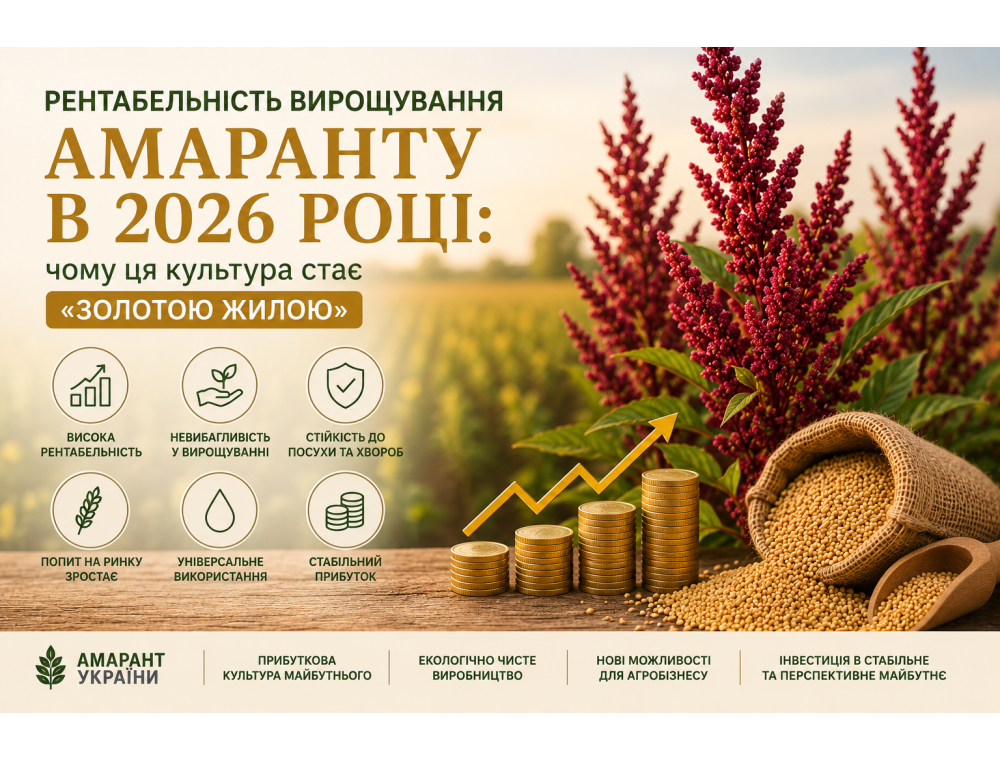
In 2026, Ukraine's agricultural sector continues to face the challenges of climate change and unstable prices for traditional grains. While wheat and sunflower show predictable but low margins, amaranth is confidently leading in terms of profitability per hectare.
1. Economic Indicators: How Much Can You Earn?
Amaranth is a high-value-added crop. While the average profitability of corn fluctuates between 15–20%, for amaranth, this figure can reach 100% to 250%, depending on the variety and technology used.
Market Price: Demand for organic and varietal amaranth in Europe and the domestic Ukrainian market is growing steadily. The price per ton of commodity grain is significantly higher than that of traditional cereals.
Low Seeding Rate: Only 1–1.5 kg of seeds is required per hectare. This means minimal investment in planting material compared to almost any other crop.
2. Comparative Table: Amaranth vs. Traditional Crops
To understand the real perspective, let's compare the costs and potential income (forecast data for the 2026 season):
| Indicator | Amaranth (Varietal) | Sunflower | Corn |
| Seeding Rate per 1 ha | 1 – 1.5 kg | 4 – 6 kg | 15 – 25 kg |
| Seed Costs | Low | High (Imported hybrids) | High |
| Water Requirement | Minimal (Drought-resistant) | Average | High |
| Average Yield | 2.0 – 3.5 t/ha | 2.5 – 3.5 t/ha | 7.0 – 10.0 t/ha |
| Market Price per 1 t | High (Niche) | Average | Low |
| Est. Profitability | 150% – 250% | 40% – 60% | 15% – 30% |
3. Climate Resilience: The Answer to Drought
One of the main advantages of amaranth is its C4-type photosynthesis. Simply put: the hotter the summer, the more intensively it grows.
Amaranth requires 2–2.5 times less moisture than corn.
A deep root system allows the plant to "reach" water where other crops simply burn out.
4. Three Sources of Income from One Field
Growing amaranth provides a zero-waste production cycle:
Seeds: For the production of oil (rich in squalene), flour, and superfoods.
Green Mass: An ideal high-protein feed. Amaranth silage increases milk yields and weight gain in livestock.
Processing: Use in pharmacology and cosmetology.
5. The Technological Secret of Success — High-Quality Seeds
Profitability begins with genetics, not the harvester. Using first-reproduction varietal seeds from a trusted producer guarantees:
Simultaneous Ripening: Crucial for harvesting without losses.
High Oil and Protein Content: Directly affecting the purchase price.
Purity of Crops: Absence of impurities and weeds in the seed material.
Conclusion: Amaranth in 2026 is not just an exotic plant, but a real tool for financial stability. With minimal investment in seeds, you get a crop that thrives in heat and has a guaranteed demand.
Want to calculate the profitability for your field?
We will help you choose the right variety for your region and provide a complete technological cultivation map.
Comments:


