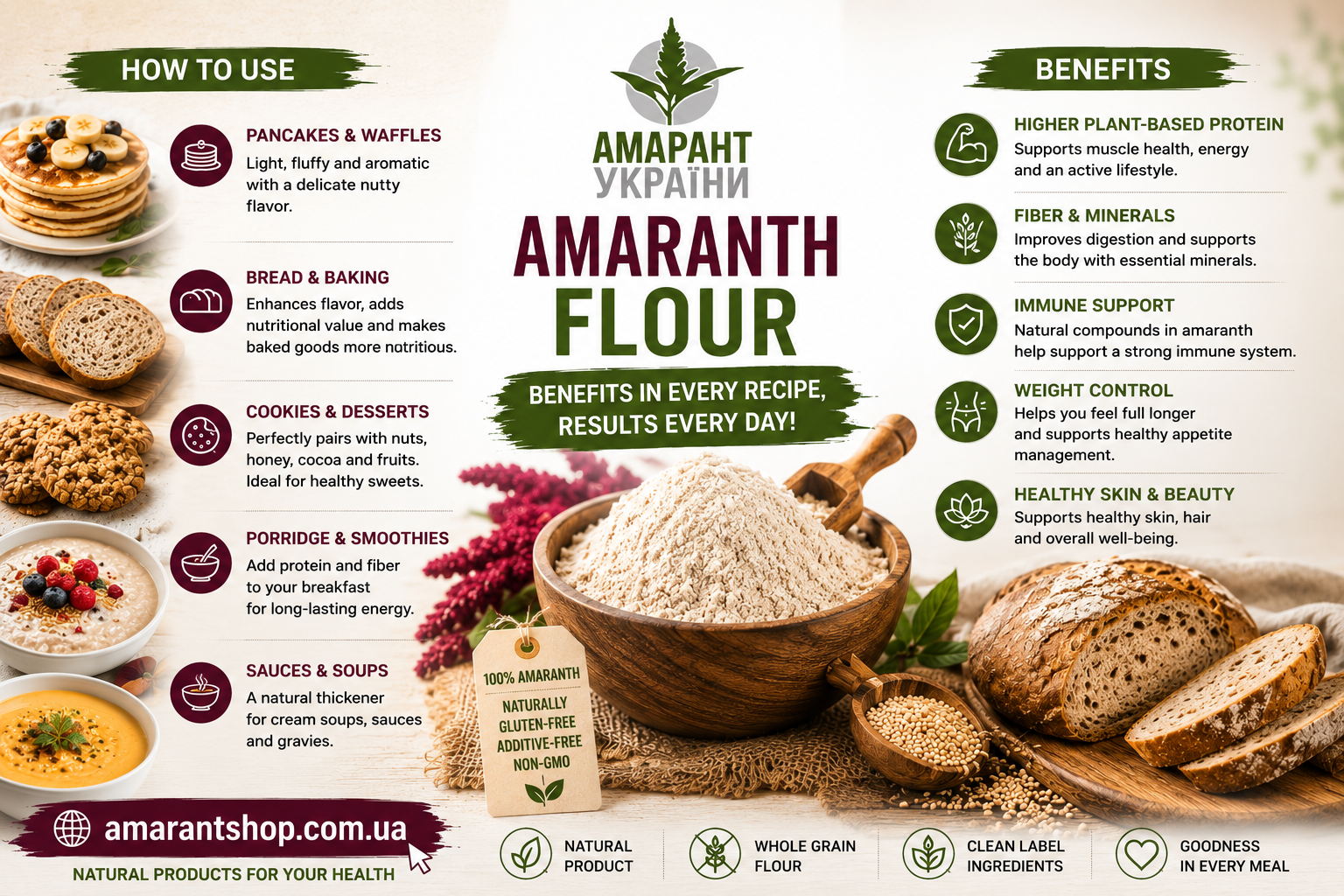
Amaranth Flour: A Superfood You Can Easily Turn into Delicious Food
What if you could make your everyday flour much more interesting?
Add a product with a pleasant nutty flavor, plant-based protein, dietary fiber, and a natural combination of valuable nutrients to your daily diet.
That product is amaranth flour.
Amaranth has been known to humanity for thousands of years. In South America, it was cultivated long before the development of the modern food industry. Today, interest in this ancient crop is growing again.
The reason is simple: amaranth perfectly meets the modern demand for natural, nutritious, and versatile foods.
And amaranth flour is one of the easiest ways to add amaranth to your everyday menu.
What Is Amaranth Flour?
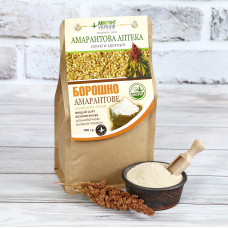
Amaranth flour is made by grinding amaranth seeds.
Unlike traditional cereal flour, amaranth is a pseudocereal. It is not a grain and is naturally gluten-free.
Our amaranth flour is made from 100% amaranth grain and has a whole-grain texture. This means the natural components of the whole grain remain in the flour.
It contains no:
wheat flour;
gluten-containing ingredients;
artificial additives;
artificial colors;
artificial flavors;
GMOs.
This makes amaranth flour an excellent choice for people who want to add more variety to their everyday diet.
Why Should You Try Amaranth Flour?
The main advantage of amaranth flour is not a single "miracle" ingredient.
Its value comes from the combination of plant-based protein, dietary fiber, minerals, and other naturally occurring components of amaranth grain.
1. Plant-Based Protein
Amaranth is notable for its relatively high protein content compared with many other plant foods.
Its protein contains essential amino acids, including lysine.
That makes amaranth flour an interesting ingredient for people who want to diversify their diet with plant-based sources of protein.
It is especially convenient to add to breakfasts, homemade baked goods, pancakes, porridge, or smoothies.
2. Naturally Gluten-Free
Amaranth is naturally gluten-free, which makes amaranth flour a popular ingredient in gluten-free cooking.
However, if the flour is intended for someone with celiac disease, it is important to consider not only the ingredients but also the production conditions and the possibility of cross-contamination.
For everyday cooking, amaranth flour is simply a great way to diversify your usual flour selection.
3. Dietary Fiber for a More Balanced Diet
Whole-grain foods are valued for their dietary fiber content.
Fiber is an important part of a balanced diet and helps increase the variety of plant-based foods in your daily menu.
That is why amaranth flour pairs well with other whole grains, vegetables, fruits, nuts, and seeds.
4. Naturally Occurring Minerals
Amaranth naturally contains minerals such as magnesium, phosphorus, iron, potassium, and calcium.
The exact nutritional composition may vary depending on the amaranth variety, growing conditions, and processing methods.
This is another reason why amaranth has attracted the attention of people who value diverse and nutritious foods.
5. A Distinctive Nutty Flavor
And this is where things get really interesting.
Amaranth flour is not simply a "healthy ingredient."
It has a delicate natural nutty aroma and flavor that can make familiar dishes more interesting.
Pancakes become more aromatic, cookies develop a richer taste, and homemade bread gets a distinctive flavor note.
That is why many people enjoy amaranth flour not only for its nutritional qualities but also for its unique taste.
How Can You Use Amaranth Flour?
You do not have to completely replace your usual flour.
In fact, one of the easiest ways to start using amaranth flour is to add it to recipes you already know and love.
For Pancakes and Fritters
Replace part of your regular flour with amaranth flour.
The result is tender pancakes with a pleasant nutty aroma.
For Homemade Bread
Add amaranth flour to your regular flour blend.
It can enrich the recipe with plant-based protein and give the bread a distinctive flavor.
For Cookies
Amaranth flour pairs beautifully with:
nuts;
honey;
dried fruit;
cinnamon;
cocoa;
coconut.
This makes it easy to create delicious homemade cookie recipes.
For Porridge
Add 1–2 tablespoons of amaranth flour to cooked porridge and mix well.
It is a simple way to make an everyday breakfast more nutritious and flavorful.
For Smoothies
A small amount of amaranth flour can be added to fruit and berry smoothies.
It works especially well with bananas, berries, nuts, or plant-based milk.
For Sauces and Soups
Amaranth flour can also be used as a natural thickener for sauces, gravies, and cream soups.
Can You Replace Wheat Flour with Amaranth Flour?
Yes, but not always in a 1:1 ratio.
Because amaranth does not contain gluten, dough made entirely with amaranth flour behaves differently from wheat-based dough.
For your first recipes, we recommend replacing around 10–30% of the total flour with amaranth flour.
For example:
200 g regular flour + 50 g amaranth flour.
This allows you to gradually discover the flavor and find the proportion you enjoy most.
For completely gluten-free baking, amaranth flour can be combined with rice flour, corn flour, buckwheat flour, or other gluten-free ingredients.
Amaranth Flour Is Not Only for People "On a Diet"
This is an important point.
Amaranth flour is often viewed exclusively as a diet or gluten-free product.
But its potential audience is much broader.
For families — to add variety to homemade baking.
For athletes and active people — as an additional plant-based protein ingredient in a varied diet.
For vegetarians and vegans — to increase the variety of plant-based foods in their meals.
For people following a gluten-free diet — as one of many naturally gluten-free flour options.
For home baking enthusiasts — because of its distinctive nutty flavor.
And simply for anyone who enjoys trying something new.
What Can You Make with Amaranth Flour?
Here are a few ideas to get you started.
For breakfast:
amaranth pancakes;
fritters;
cheesecakes with amaranth flour;
porridge with amaranth flour;
nutritious smoothies.
For tea or coffee:
homemade cookies;
cakes;
muffins;
amaranth sponge cake.
For lunch and dinner:
bread;
homemade flatbreads;
breading and coatings;
sauces;
cream soups.
And if you enjoy experimenting in the kitchen, try adding amaranth flour to banana pancakes, apple pie, or homemade energy bars.
Why Do We Choose Whole-Grain Amaranth?
We believe that a good product starts not with attractive packaging, but with quality raw materials.
That is why our amaranth flour is made from whole amaranth grain.
From growing the grain to processing it, we focus on preserving the natural qualities of the raw material and creating a product that fits naturally into a modern kitchen.
100% amaranth. Nothing unnecessary.
No complicated ingredients.
No need to invent special recipes.
Simply add it to the dishes you already love.
How to Choose Amaranth Flour
Before buying amaranth flour, pay attention to several things.
Ingredients. The simpler the ingredient list, the easier it is to understand what you are buying. A quality product should clearly state what it is made from.
Texture and milling. Fine flour is convenient for baking because it mixes easily with other ingredients.
Origin of the raw material. It is worth knowing who produces the product and where the amaranth grain comes from.
Packaging and storage conditions. Whole-grain flour contains natural components of the grain, so it should be stored properly.
Production date and shelf life.
Amaranth That Is Easy to Add to Your Everyday Life
You do not have to completely change the way you eat to make your diet more diverse.
Sometimes, one simple change is enough.
Add a spoonful of amaranth flour to your porridge.
Replace part of the regular flour in your pancakes.
Bake homemade cookies.
Try a new bread recipe.
And gradually discover a food that was an important part of traditional diets thousands of years ago and is becoming popular again today.
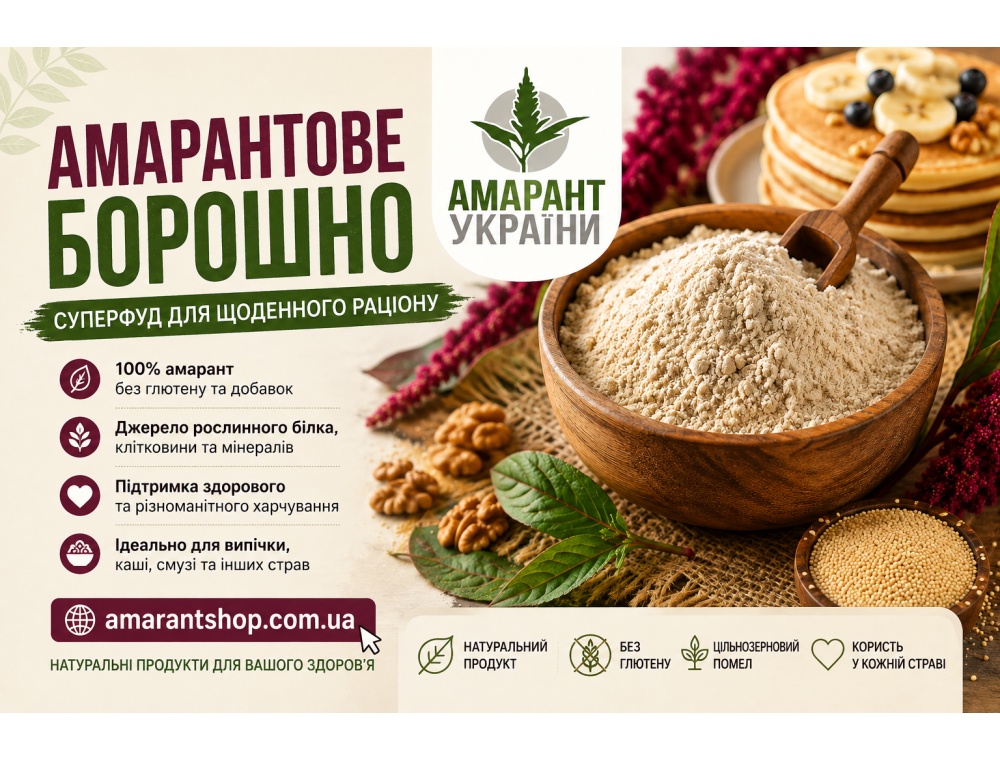
Amaranth Flour by Amarant Ukraine — a natural way to add variety to your everyday menu.
- 100% Amaranth
- Whole-Grain Flour
- Naturally Gluten-Free
- No Unnecessary Additives
- Made in Ukraine
- Try amaranth flour and discover a new flavor in your favorite everyday dishes.
Comments: